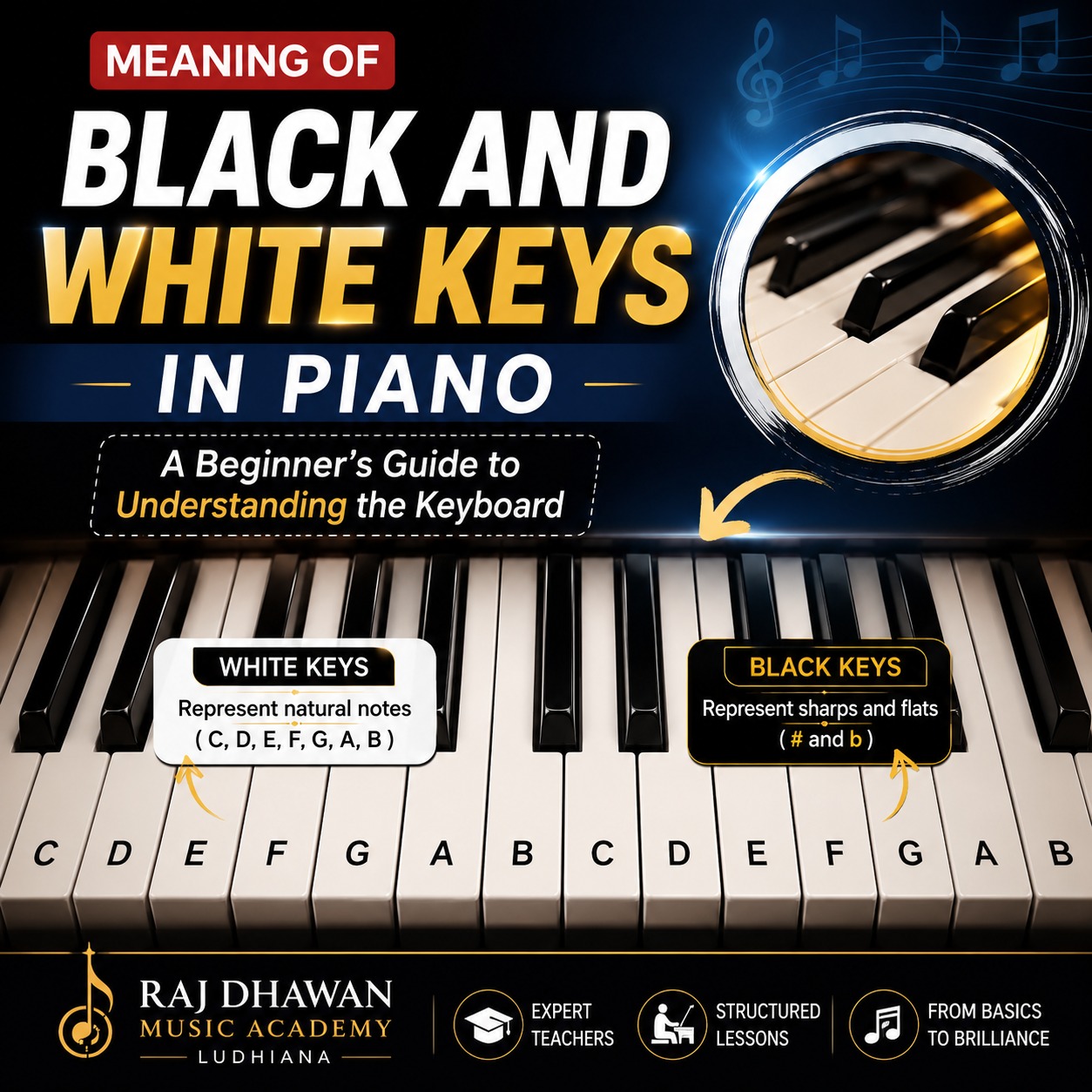
A Beginner’s Guide to Understanding the Keyboard
If you’ve ever looked at a piano for the first time, you’ve probably wondered why it has both black and white keys. At first glance, the pattern may seem confusing, but once you understand the purpose of these keys, the piano keyboard becomes much easier to navigate.
Whether you’re a beginner starting your musical journey or a parent looking for piano lessons for your child, understanding the black and white keys is one of the first steps toward learning piano effectively.
At Raj Dhawan Music Academy, students are introduced to the piano keyboard in a simple and practical way, helping them build a strong foundation before moving on to songs, chords, and advanced techniques.
In this guide, we’ll explore the meaning of black and white keys, how they work together, and why they are essential in creating music.
Understanding the Piano Keyboard
A standard piano has 88 keys made up of:
- 52 white keys
- 36 black keys
These keys are arranged in a repeating pattern across the keyboard.
When beginners first see a piano, they often focus on memorizing notes. However, understanding the pattern of black and white keys makes learning much easier.
The keyboard is designed in a logical way, allowing musicians to find notes quickly and play music smoothly.
What Do the White Keys Represent?
The white keys represent the natural musical notes:
- C
- D
- E
- F
- G
- A
- B
These seven notes form the foundation of Western music.
After B, the pattern repeats again:
C → D → E → F → G → A → B → C
This repeating sequence continues across the entire keyboard.
For beginners, most simple melodies and exercises are learned using white keys before moving to more advanced concepts.
What Do the Black Keys Represent?
The black keys represent sharp (#) and flat (♭) notes.
They are positioned between certain white keys and allow musicians to play notes that fall between the natural notes.
For example:
- The black key between C and D can be called C# (C Sharp)
- The same key can also be called D♭ (D Flat)
Similarly:
- D# = E♭
- F# = G♭
- G# = A♭
- A# = B♭
These notes add more musical possibilities and help create different scales, chords, and melodies.
Why Are Black Keys Arranged in Groups?
One of the easiest ways to identify notes on a piano is by observing the pattern of black keys.
You’ll notice they appear in repeating groups:
- Two black keys
- Three black keys
This pattern repeats across the entire keyboard.
Group of Two Black Keys
The white key immediately to the left is always C.
This makes finding Middle C and other C notes much easier.
Group of Three Black Keys
The white keys around these groups help identify F, G, and A.
Once students understand this pattern, locating notes becomes much faster.
Why Doesn’t Every White Key Have a Black Key Between It?
A common question among beginners is:
“Why is there no black key between E and F or between B and C?”
The answer lies in music theory.
The distance between:
- E and F
- B and C
is already a half step (or semitone).
Because these notes are naturally very close together, there is no need for an additional black key between them.
This design creates the unique structure of the piano keyboard and forms the basis of scales and harmony.
How Black and White Keys Work Together
The piano keyboard is designed to provide all twelve notes used in Western music.
These include:
White Keys (Natural Notes)
C, D, E, F, G, A, B
Black Keys (Sharps and Flats)
C#, D#, F#, G#, A#
Together, they create a complete musical system that allows musicians to play:
- Classical music
- Pop songs
- Bollywood music
- Jazz
- Rock
- Punjabi songs
- Devotional music
Without black keys, many melodies and chords would not exist.
Why Beginners Should Learn Keyboard Patterns First
Many new piano students try to memorize every key individually.
A better approach is understanding the keyboard pattern.
When students recognize:
- Groups of two black keys
- Groups of three black keys
- Location of C notes
- Repeating note patterns
they learn the keyboard much faster.
This approach also helps with:
- Reading music
- Playing scales
- Learning chords
- Improving confidence
The Importance of Black Keys in Piano Playing
Black keys play a major role in music.
They are used in:
Scales
Many major and minor scales require black keys.
Chords
Advanced chords often include sharp and flat notes.
Melodies
Countless famous songs use black keys.
Musical Expression
Black keys allow musicians to create different moods and emotions.
As students progress, they discover that black keys are just as important as white keys.
Fun Fact: Some Famous Piano Pieces Use Mostly Black Keys
One interesting fact is that several famous piano compositions make extensive use of black keys.
In fact, some advanced pieces are designed around black-key patterns because they can feel surprisingly comfortable under the fingers.
This demonstrates that black keys aren’t simply “extra notes”—they are an essential part of piano playing.
Learning Piano the Right Way
Understanding the keyboard layout is one of the first lessons every piano student should master.
At Raj Dhawan Music Academy, beginners learn piano step by step, starting with:
- Keyboard orientation
- Black and white key identification
- Finger exercises
- Basic melodies
- Chord playing
- Rhythm training
This structured approach helps students build confidence and avoid confusion during the early stages of learning.
Why Professional Piano Lessons Help
Many beginners try learning piano through random videos online.
While online resources can be helpful, professional guidance often makes learning faster and more enjoyable.
A trained instructor can:
- Correct mistakes early
- Explain concepts clearly
- Provide personalized guidance
- Build proper technique
- Create a structured learning path
This is why many students searching for:
- Best piano classes in Ludhiana
- Piano lessons for beginners
- Keyboard classes in Ludhiana
- Best music academy in Ludhiana
- Music classes in Ludhiana
choose professional instruction to build a strong musical foundation.
Why Students Choose Raj Dhawan Music Academy
Raj Dhawan Music Academy offers beginner-friendly and advanced music training for students of all ages.
Students looking for:
- Best piano classes in Ludhiana
- Best music academy in Ludhiana
- Music classes in Ludhiana
- Keyboard classes in Ludhiana
- Raj Dhawan Music Academy
- Professional music training in Punjab
benefit from structured lessons, practical learning, and personalized attention.
The academy provides training in:
- Piano
- Guitar
- Vocal Music
- Harmonium
- Tabla
with a focus on both musical understanding and practical performance.