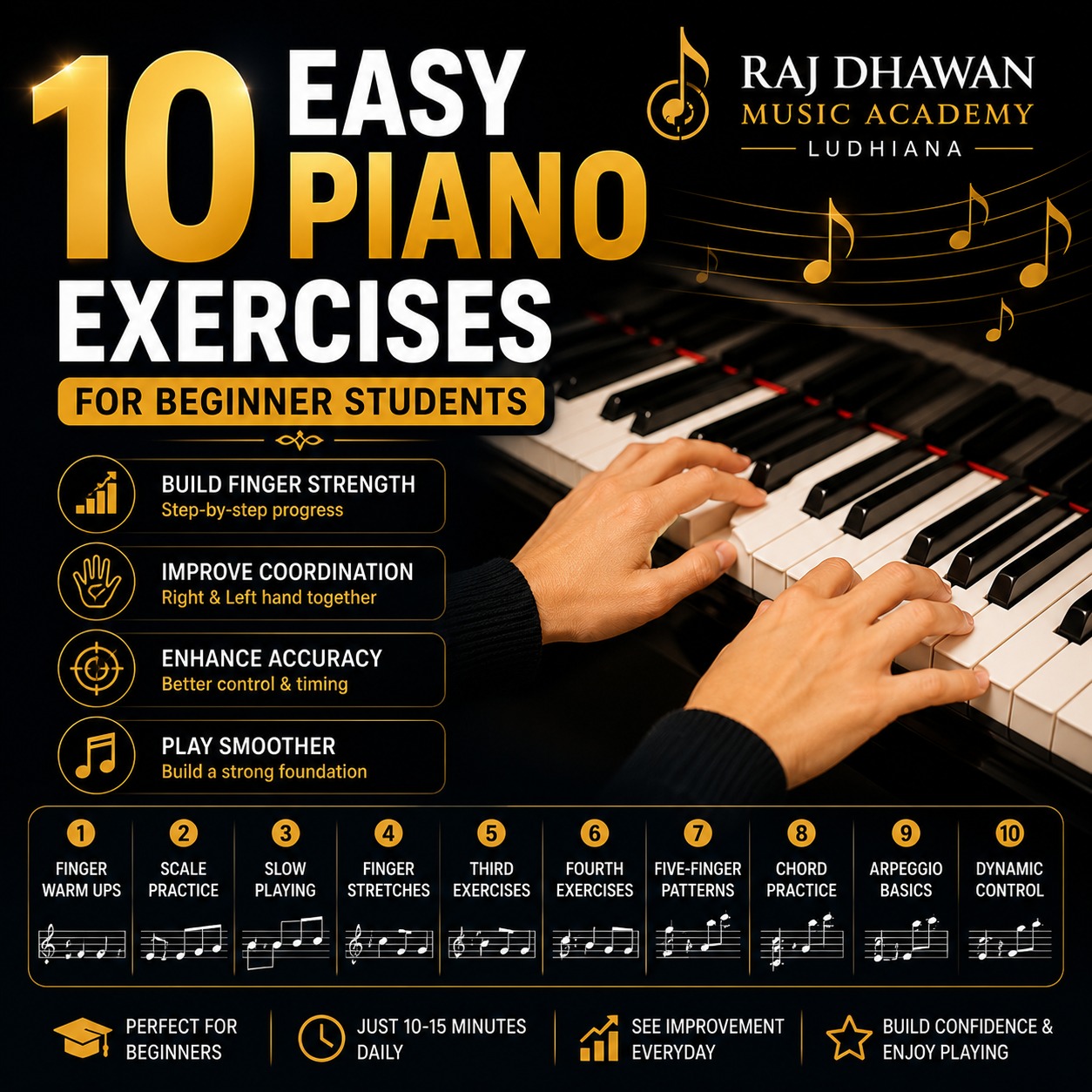
Learning piano is an exciting journey, but every great pianist starts with the basics. Before playing beautiful songs and advanced pieces, beginners need to develop finger strength, hand coordination, rhythm, and confidence on the keyboard.
This is where piano exercises become important.
Many students want to jump directly into playing songs, but simple daily exercises help build the foundation needed for smooth and effortless piano playing later on. Just 15–20 minutes of focused practice each day can dramatically improve your technique and overall progress.
At Raj Dhawan Music Academy, beginner students are introduced to easy piano exercises that improve finger control, hand independence, note recognition, and rhythm in a structured way.
If you’re looking for beginner-friendly piano exercises, here are 10 simple exercises that can help you become a better pianist.
Why Are Piano Exercises Important?
Before we start, let’s understand why piano exercises matter.
Regular exercises help improve:
- Finger strength
- Hand coordination
- Playing speed
- Accuracy
- Rhythm control
- Muscle memory
- Keyboard familiarity
- Confidence while playing
Think of piano exercises as warm-ups for musicians, just like athletes warm up before sports.
1. Five-Finger Exercise
This is one of the first exercises every piano student learns.
How to Practice
Place your fingers on:
- C = Thumb (1)
- D = Index (2)
- E = Middle (3)
- F = Ring (4)
- G = Little Finger (5)
Play:
C – D – E – F – G
Then return:
G – F – E – D – C
Benefits
- Improves finger independence
- Develops control
- Strengthens weaker fingers
Practice slowly and evenly.
2. Finger Lifting Exercise
Many beginners struggle because their fingers move together instead of independently.
How to Practice
Place all five fingers on:
C D E F G
Lift one finger at a time while keeping the others relaxed.
Benefits
- Improves finger independence
- Builds control
- Reduces tension
This simple exercise creates a strong technical foundation.
3. C Major Scale Exercise
The C Major Scale is often the first scale beginners learn.
Play:
C – D – E – F – G – A – B – C
Then return downward.
Benefits
- Teaches note patterns
- Improves coordination
- Develops fingering skills
- Increases keyboard familiarity
Scales are used by pianists at every level.
4. Right-Hand Only Exercise
Many students try using both hands too early.
Instead, focus on one hand first.
Practice
Play simple note sequences using only the right hand:
C D E F G
Then:
G F E D C
Benefits
- Improves hand control
- Builds confidence
- Strengthens finger movement
Mastering each hand individually makes two-hand playing easier later.
5. Left-Hand Only Exercise
The left hand often feels weaker than the right hand.
This exercise helps balance both hands.
Practice
Play:
C D E F G
using the left hand only.
Benefits
- Builds left-hand strength
- Improves coordination
- Increases independence
Don’t neglect your left hand—it plays a vital role in piano music.
6. Alternate Finger Exercise
Play the same note repeatedly using different fingers.
For example:
C using:
1 – 2 – 3 – 4 – 5
Repeat slowly.
Benefits
- Improves finger control
- Develops flexibility
- Increases accuracy
This exercise may seem simple, but it’s highly effective.
7. Rhythm Clapping Exercise
Piano is not only about notes.
Rhythm is equally important.
Before playing notes, clap simple patterns:
- 1 2 3 4
- 1 & 2 & 3 & 4 &
- Slow and fast patterns
Benefits
- Improves timing
- Strengthens rhythm understanding
- Helps maintain steady tempo
Good rhythm is one of the most important musical skills.
8. Hands Together Exercise
Once you’re comfortable with individual hands, combine them.
Practice
Both hands play:
C D E F G
Then return.
Start slowly.
Benefits
- Improves coordination
- Develops synchronization
- Builds confidence
Many beginners find this challenging initially, but regular practice makes it easier.
9. Chord Exercise
Learning basic chords helps students understand harmony.
Start With
C Major:
- C
- E
- G
Play the chord repeatedly.
Then practice:
- F Major
- G Major
- A Minor
Benefits
- Improves finger positioning
- Develops chord recognition
- Helps prepare for songs
Most popular songs are built using basic chords.
10. Metronome Exercise
A metronome is one of the most valuable tools for beginners.
How to Practice
Set a slow tempo.
Play simple note patterns while matching the beat.
Benefits
- Improves timing
- Builds consistency
- Develops professional practice habits
Students who practice with a metronome often progress faster than those who don’t.
Sample 20-Minute Beginner Piano Practice Routine
If you’re unsure how to structure your practice, try this simple routine.
5 Minutes
Five-finger exercise
5 Minutes
C Major Scale
3 Minutes
Finger independence exercises
3 Minutes
Chord practice
4 Minutes
Simple song or melody
This routine helps build both technique and musical understanding.
Common Mistakes Beginners Make During Exercises
Playing Too Fast
Speed should come after accuracy.
Practicing Without Rhythm
Always maintain a steady beat.
Skipping Warm-Ups
Warm-ups prepare your fingers and brain.
Practicing Inconsistently
Daily practice is more effective than occasional long sessions.
Ignoring Finger Numbers
Proper fingering creates better technique.
How Long Should Beginners Practice Piano?
Many students believe they need several hours daily.
That’s not true.
For beginners:
- 20–30 minutes daily is excellent.
- Consistency matters more than duration.
- Small daily improvements create significant long-term progress.
Even professional pianists built their skills through regular practice over time.
Why Professional Piano Guidance Helps
While exercises can be practiced independently, professional instruction ensures you’re practicing correctly.
A qualified teacher can:
- Correct posture
- Improve hand position
- Fix fingering mistakes
- Create personalized exercises
- Keep students motivated
This is why many students searching for:
- Best piano classes in Ludhiana
- Piano lessons for beginners
- Keyboard classes in Ludhiana
- Best music academy in Ludhiana
- Piano teacher in Ludhiana
choose structured learning for faster and more effective progress.
Learn Piano at Raj Dhawan Music Academy
At Raj Dhawan Music Academy, students learn piano through a balanced combination of exercises, music theory, rhythm training, scales, chords, and song performance.
The academy offers:
- Beginner piano lessons
- Advanced keyboard training
- Finger development exercises
- Hand coordination techniques
- Music theory fundamentals
- Practical song learning
Students receive personalized attention designed to help them progress confidently and develop strong musical foundations.
Why Students Choose Raj Dhawan Music Academy
Students looking for:
- Best piano classes in Ludhiana
- Piano lessons in Ludhiana
- Keyboard classes in Ludhiana
- Best music academy in Ludhiana
- Music classes in Ludhiana
- Online piano classes Punjab
- Professional piano teacher in Ludhiana
often choose Raj Dhawan Music Academy for its structured teaching methods, practical approach, and supportive learning environment.
In addition to piano classes, the academy also offers:
- Guitar Classes
- Vocal Training
- Harmonium Lessons
- Tabla Classes
making it a complete destination for music education.