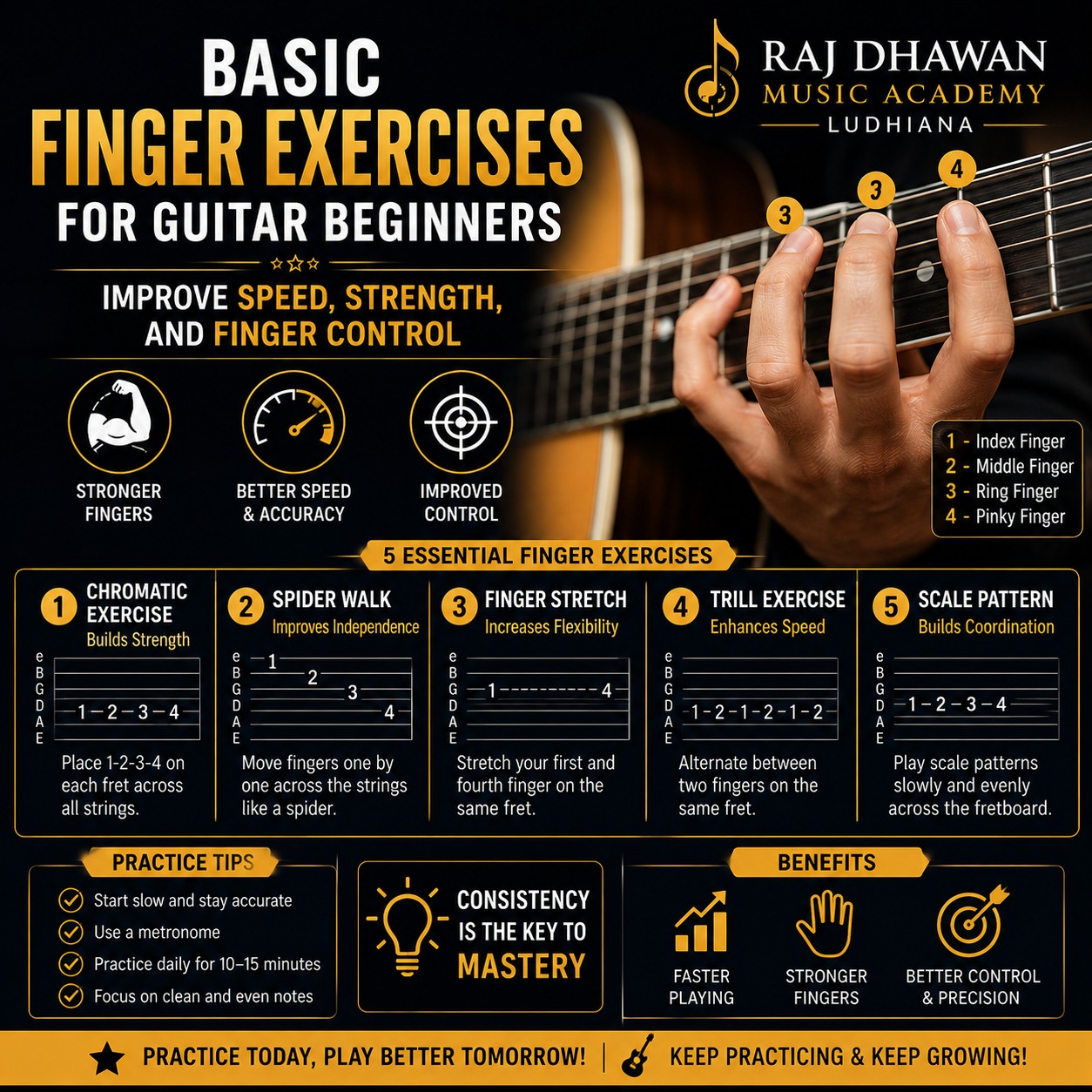
Learning guitar is exciting, but every beginner quickly realizes that finger movement is one of the biggest challenges. Chord changes feel slow, fingers don’t stretch properly, and playing even simple songs can seem difficult in the beginning.
The good news is that this is completely normal.
Every skilled guitarist you admire once struggled with the same challenges. The difference is that they developed strong finger strength, flexibility, and coordination through regular practice and simple finger exercises.
If you’re serious about learning guitar, finger exercises should become part of your daily routine. These exercises help improve speed, accuracy, finger independence, and overall playing comfort.
At Raj Dhawan Music Academy, students are encouraged to practice finger exercises before moving on to chords, scales, and songs. This helps build a strong technical foundation and allows students to progress faster.
Whether you’re learning at home or searching for the best guitar classes in Ludhiana, mastering these beginner finger exercises can dramatically improve your guitar-playing skills.
Why Are Finger Exercises Important for Guitar Players?
Many beginners focus only on learning songs.
While songs are fun, finger exercises build the skills needed to play those songs smoothly.
Regular finger exercises help improve:
- Finger strength
- Finger independence
- Speed and accuracy
- Chord transition ability
- Hand coordination
- Muscle memory
- Fretboard confidence
- Playing endurance
Without proper finger development, even simple guitar techniques can feel difficult.
That’s why students attending the best guitar classes in Ludhiana spend time developing their technique before moving on to more advanced playing.
Exercise 1: The Famous 1-2-3-4 Exercise
The 1-2-3-4 exercise is one of the most effective beginner guitar exercises.
How to Practice
Start on the low E string.
Play:
- 1st fret using Index Finger
- 2nd fret using Middle Finger
- 3rd fret using Ring Finger
- 4th fret using Little Finger
Move to the next string and repeat the pattern.
Continue until you reach the high E string.
Benefits
- Develops finger independence
- Improves coordination
- Strengthens weaker fingers
- Increases fretboard familiarity
Start slowly and focus on clean notes rather than speed.
Exercise 2: Spider Walk Exercise
The Spider Walk helps improve coordination between your fingers.
How to Practice
Play:
- Index Finger on 1st fret
- Ring Finger on 3rd fret
Move to the next string:
- Middle Finger on 2nd fret
- Little Finger on 4th fret
Continue this alternating pattern across all strings.
Benefits
- Improves finger control
- Develops stretching ability
- Builds finger independence
- Enhances accuracy
This exercise may feel awkward initially, but it becomes easier with practice.
Exercise 3: Finger Stretch Exercise
Many beginners struggle with finger reach.
This exercise improves flexibility.
Practice Pattern
Play:
- 1st fret
- 3rd fret
- 5th fret
Use:
- Index Finger
- Ring Finger
- Little Finger
Practice on each string.
Benefits
- Improves flexibility
- Increases finger reach
- Makes chord shapes easier
- Reduces hand tension
Remember not to force your fingers beyond a comfortable range.
Exercise 4: Single String Finger Control Exercise
Choose one string and play:
1 – 2 – 3 – 4
Then return:
4 – 3 – 2 – 1
Practice slowly and evenly.
Benefits
- Builds finger control
- Improves note accuracy
- Strengthens weaker fingers
- Enhances rhythm consistency
This simple exercise is excellent for beginners.
Exercise 5: Alternate Picking Exercise
Your picking hand is just as important as your fretting hand.
Practice
Play a single note repeatedly using:
- Downstroke
- Upstroke
- Downstroke
- Upstroke
Continue slowly while maintaining consistent timing.
Benefits
- Improves picking accuracy
- Develops rhythm
- Increases playing speed
- Builds hand synchronization
Alternate picking is used in almost every style of guitar playing.
Exercise 6: Finger Independence Drill
Many beginners notice that multiple fingers move together.
This exercise trains each finger to move independently.
How to Practice
Place:
- Index Finger on 1st fret
- Middle Finger on 2nd fret
- Ring Finger on 3rd fret
- Little Finger on 4th fret
Lift one finger at a time while keeping the others pressed down.
Benefits
- Improves finger independence
- Builds control
- Strengthens weaker fingers
- Reduces unnecessary movement
This exercise is surprisingly effective.
Exercise 7: Basic Chord Transition Practice
Finger exercises don’t always have to involve individual notes.
Chord transitions are one of the best practical exercises for beginners.
Practice Switching Between
- C Major → G Major
- G Major → D Major
- A Minor → E Minor
Focus on smooth movement rather than speed.
Benefits
- Builds muscle memory
- Improves real-world guitar skills
- Makes song learning easier
- Develops finger coordination
Exercise 8: Table Finger Tapping Exercise
Even when you’re away from your guitar, you can improve finger control.
Practice
Place your hand on a table.
Tap:
- Index Finger
- Middle Finger
- Ring Finger
- Little Finger
One at a time.
Benefits
- Improves finger independence
- Strengthens weaker fingers
- Can be practiced anywhere
This is perfect for students, office workers, or anyone with limited practice time.
Exercise 9: Chromatic Exercise
The chromatic exercise is commonly taught in professional guitar lessons.
Pattern
Play:
1 – 2 – 3 – 4
Move up one fret and repeat.
Continue up the fretboard.
Benefits
- Builds finger strength
- Improves fretboard awareness
- Enhances coordination
- Develops accuracy
Use a metronome for better results.
Exercise 10: Daily Guitar Warm-Up Routine
Before every practice session, spend a few minutes warming up.
2 Minutes
Finger stretching
2 Minutes
1-2-3-4 exercise
2 Minutes
Spider Walk exercise
2 Minutes
Basic chord transitions
2 Minutes
Simple scale practice
Benefits
- Prepares fingers for playing
- Reduces stiffness
- Improves performance
- Prevents bad habits
A proper warm-up can significantly improve your practice quality.
How Long Should Beginners Practice Finger Exercises?
One common mistake is spending all your practice time on exercises.
Balance is important.
Recommended Routine
- 10–15 minutes finger exercises
- 10–15 minutes chord practice
- 10–20 minutes song practice
This combination develops both technical ability and musical enjoyment.
Common Mistakes Beginners Make
Pressing Too Hard
Use only enough pressure to produce a clear note.
Playing Too Fast
Speed comes later.
Accuracy comes first.
Ignoring the Little Finger
Your little finger is weak initially but extremely important.
Train it regularly.
Practicing Inconsistently
Daily practice produces better results than occasional long sessions.
Skipping Warm-Ups
Always prepare your fingers before playing.
Benefits of Daily Finger Exercises
Students who consistently practice finger exercises often notice:
- Faster chord changes
- Better finger strength
- Improved note clarity
- Greater playing speed
- Better hand coordination
- Increased confidence
- Easier song learning
Small daily improvements create major long-term results.
Why Professional Guitar Training Helps
While online tutorials are useful, many beginners struggle because they don’t know which exercises to prioritize.
A professional guitar instructor can:
- Correct technique mistakes
- Improve finger positioning
- Create structured practice routines
- Build strong fundamentals
- Accelerate learning
This is why students looking for the best guitar classes in Ludhiana often achieve faster progress through guided instruction.
Learn Guitar with Raj Dhawan Music Academy
At Raj Dhawan Music Academy, beginner guitar students learn through a structured and practical approach designed to build confidence and strong technical skills.
The guitar program includes:
- Finger exercises
- Chord training
- Strumming patterns
- Rhythm development
- Scale practice
- Lead guitar basics
- Song learning
- Performance preparation
Students receive personalized guidance that helps them avoid common mistakes and develop proper technique from day one.
Whether you’re a complete beginner or someone looking to improve your skills, the academy provides professional music education in a supportive learning environment.
Why Students Choose Raj Dhawan Music Academy
Students searching for:
- Best Guitar Classes in Ludhiana
- Guitar Classes in Ludhiana
- Raj Dhawan Guitar Classes
- Guitar Lessons for Beginners in Ludhiana
- Acoustic Guitar Classes Ludhiana
- Guitar Teacher in Ludhiana
- Best Music Academy in Ludhiana
- Music Classes in Ludhiana
- Professional Guitar Training Ludhiana
often choose Raj Dhawan Music Academy because of its structured teaching methods, personalized attention, and practical learning approach.
The academy also offers:
- Piano Classes
- Vocal Music Training
- Harmonium Lessons
- Tabla Classes
making it one of the most trusted destinations