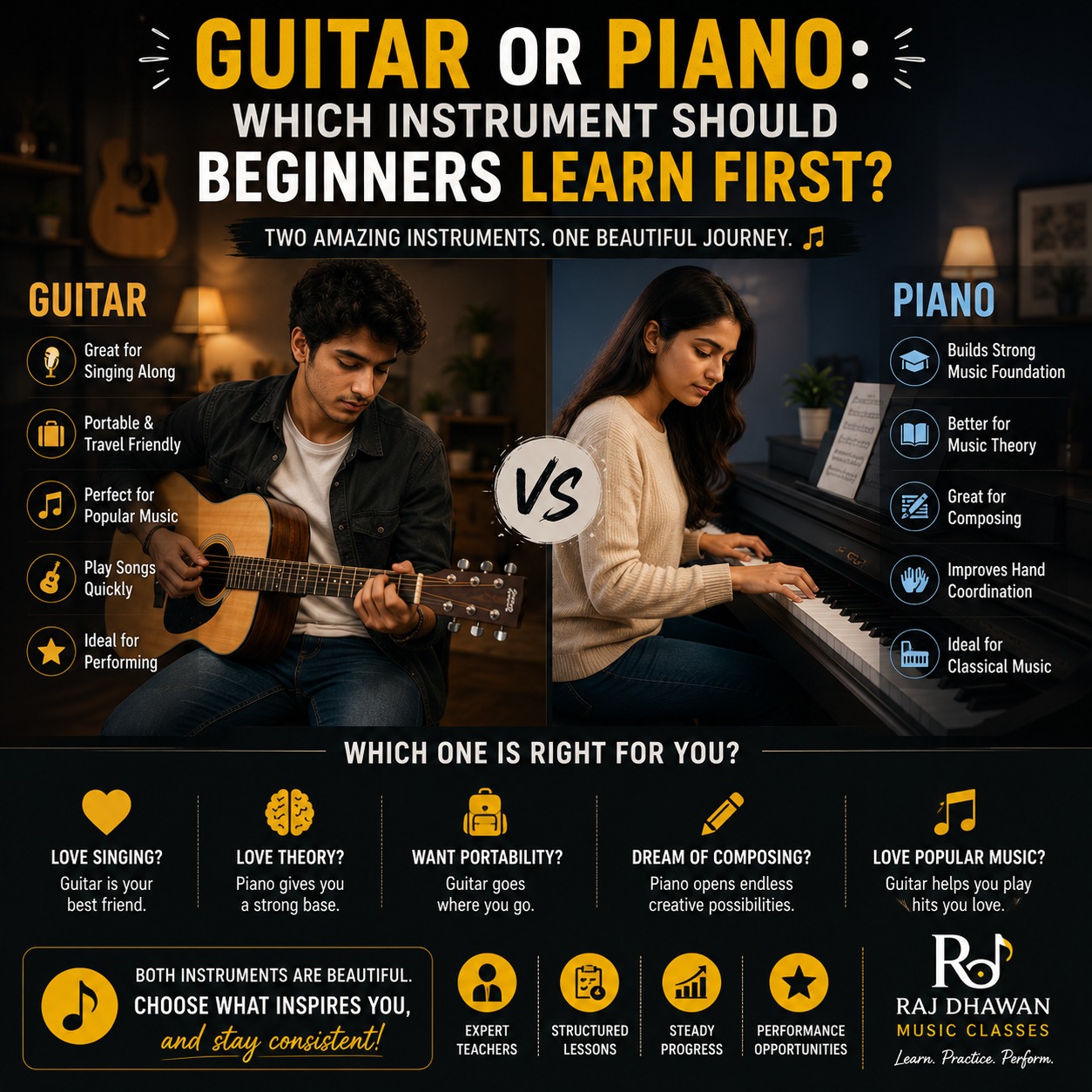
One of the most common questions aspiring musicians ask is, “Should I learn guitar or piano first?” It’s an important decision because the instrument you choose will shape your learning experience, practice routine, and even the type of music you enjoy playing.
The truth is, there isn’t a universally “better” instrument. Both guitar and piano are fantastic choices for beginners, but they suit different personalities, musical goals, and learning styles.
Whether you’re searching for guitar lessons, piano lessons, online guitar classes, or a trusted music academy Ludhiana, this guide will help you choose the instrument that’s right for you.
Before You Decide, Ask Yourself These Questions
Instead of asking which instrument is easier, ask yourself:
- What type of music do I enjoy listening to?
- Do I want to sing while playing?
- Am I interested in composing music?
- Will I be practicing mostly at home or performing with friends?
- Which instrument excites me the most?
The instrument that motivates you to practice consistently is usually the right choice.
Why Choose Guitar?
The guitar is one of the world’s most popular instruments, and for good reason. It’s portable, versatile, and works well across many genres, including Bollywood, pop, rock, indie, worship music, blues, and acoustic performances.
Many beginners choose guitar because they want to accompany their singing or play their favorite songs with friends.
Guitar is a great choice if you:
- Love singing while playing.
- Enjoy acoustic or rock music.
- Want a portable instrument.
- Like performing with friends.
- Dream of writing your own songs.
With regular guitar lessons, many beginners can start playing simple songs within a few months.
Why Choose Piano?
The piano is often considered one of the best instruments for learning the fundamentals of music.
Unlike the guitar, every key is laid out in a straight line, making it easier to understand notes, scales, and chords visually. This is one reason many music teachers recommend piano for students who want to develop a strong understanding of music theory.
Piano is a great choice if you:
- Enjoy classical music.
- Love film scores and instrumental music.
- Want to understand music theory more deeply.
- Plan to compose music.
- Prefer a visual approach to learning.
Professional piano lessons also improve hand coordination and help students develop excellent rhythm and listening skills.
Which Instrument Is Easier for Beginners?
This question doesn’t have a simple answer.
Guitar
The first few weeks can be physically challenging. Beginners often experience sore fingertips while learning chord shapes and changing between chords.
However, once these basics become comfortable, playing songs becomes much easier.
Piano
Producing a clean note is easier because pressing a key immediately creates the correct sound.
The challenge comes later, when students begin coordinating both hands independently while reading music.
In short:
The guitar feels harder at first but becomes easier over time.
The piano feels easier in the beginning but gradually becomes more technically demanding.
Which Instrument Helps You Learn Music Theory Faster?
If your goal is to understand how music works, the piano has a slight advantage.
Because every note is visible in a logical sequence, concepts such as scales, intervals, chords, and harmony become easier to understand.
This is why many professional musicians begin with piano before learning additional instruments.
That said, students taking structured guitar lessons also learn music theory as part of a well-designed curriculum.
Which Instrument Is Better for Singing?
If you enjoy singing, the guitar is often the preferred choice.
Its portability and simple chord progressions make it perfect for accompanying vocals at home, college events, family gatherings, or live performances.
Many singer-songwriters build their careers around acoustic guitar because it’s easy to carry and works beautifully with vocals.
Which Instrument Is Better for Children?
Both instruments are excellent choices for children.
Young learners interested in melodies, creativity, and visual learning often enjoy piano lessons.
Children who love popular music, performing, or singing usually find guitar more exciting.
The most important factor is choosing the instrument that keeps the child motivated to practice.
Which Instrument Is Better for Adults?
Adults often worry that they’ve started learning too late.
The reality is that thousands of adults successfully learn both guitar and piano every year.
Many working professionals prefer online guitar classes because they offer flexible schedules and allow students to learn from home.
Adults interested in composing or relaxing through music often enjoy piano just as much.
Can Learning One Instrument Help You Learn the Other?
Absolutely.
Music theory, rhythm, ear training, and timing apply to every instrument.
Students who first learn guitar often find it easier to understand chords when they begin piano.
Likewise, students with piano experience usually understand harmony and scales more quickly when learning guitar.
Learning either instrument builds a strong musical foundation.
Should You Learn Online or Offline?
Today, students have more learning options than ever.
Professional online guitar classes provide live instruction, personalized feedback, and flexible scheduling.
Offline classes offer face-to-face interaction, immediate corrections, and opportunities to perform with other students.
The best option depends on your schedule, learning style, and location.
If you’re looking for guitar classes in Ludhiana or searching for music classes near me, choosing an academy with experienced instructors and a structured curriculum will help you progress faster than learning from random online videos alone.
Why Learning with a Professional Music Academy Makes a Difference
Whether you choose guitar or piano, learning under experienced teachers helps you build the right habits from the beginning.
A professional music academy Ludhiana provides:
- Structured lessons
- Personalized guidance
- Performance opportunities
- Music theory training
- Regular feedback
- Motivation to stay consistent
Instead of wondering what to learn next, you’ll follow a clear roadmap designed for steady progress.
Final Verdict
There is no wrong choice.
Choose guitar if you love singing, want a portable instrument, and enjoy playing popular songs with friends.
Choose piano if you’re interested in understanding music theory, composing, or exploring classical and instrumental music.
The most important factor isn’t the instrument you choose—it’s how consistently you practice and the guidance you receive along the way.
Whether you’re looking for guitar lessons, piano lessons, online guitar classes, guitar classes near me, guitar classes in Ludhiana, music classes near me, or a trusted music academy Ludhiana, finding the right teacher will make your musical journey more enjoyable and rewarding.
Remember, every accomplished musician started with a single lesson. The best time to begin is today.
Frequently Asked Questions
Is guitar easier than piano?
Both instruments have different learning curves. Guitar is physically more challenging at first, while piano becomes more complex as you progress.
Can I learn both guitar and piano?
Yes. Many musicians learn both instruments. Starting with one helps you build skills that transfer to the other.
Which instrument is better for children?
Both are excellent choices. The best option depends on the child’s interests, personality, and musical goals.
Can adults start learning guitar or piano?
Absolutely. Age is never a barrier to learning music. With regular practice and proper guidance, adults can become confident musicians.
Should I take online or offline lessons?
Both methods work well. Online guitar classes offer flexibility, while offline lessons provide face-to-face interaction and immediate feedback.