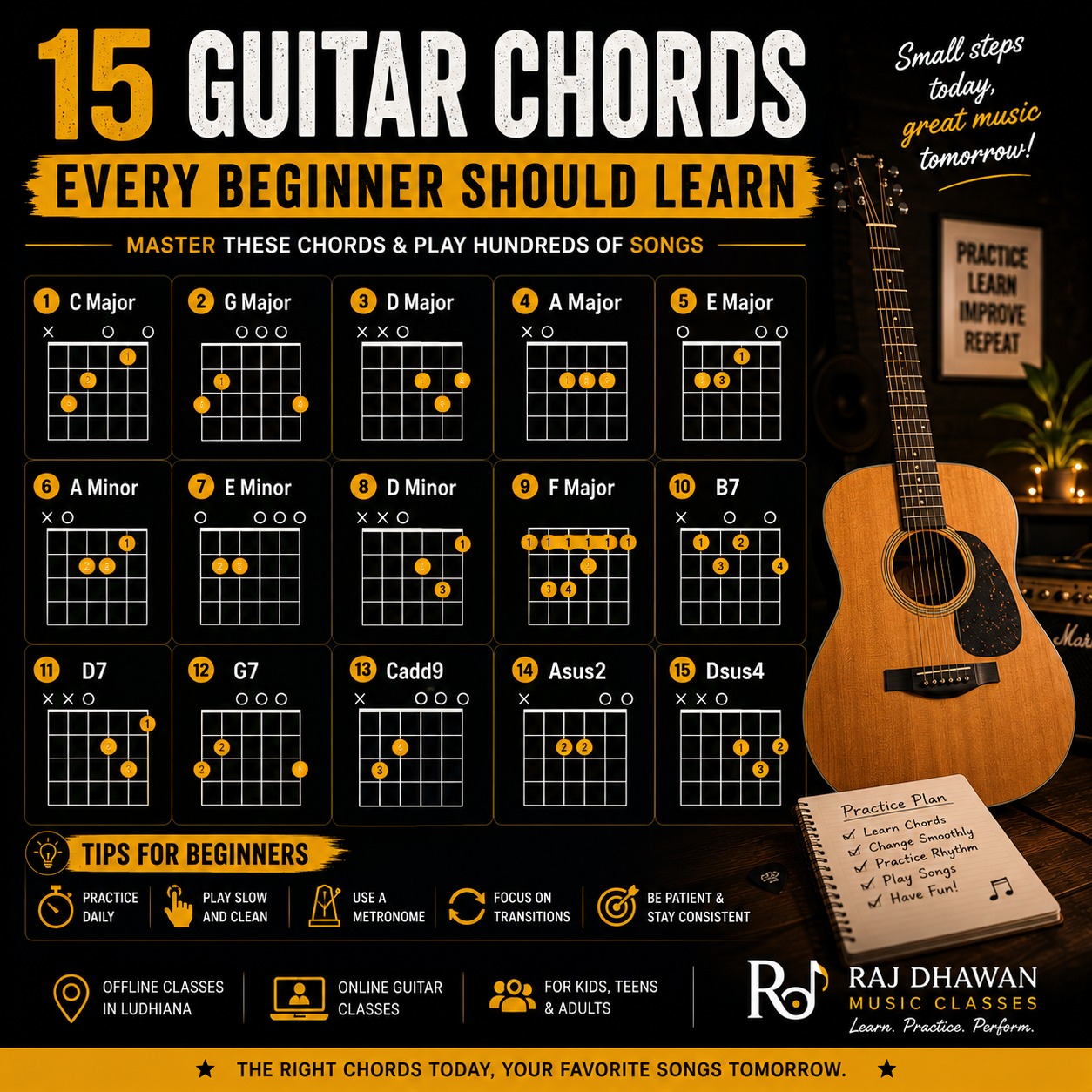
15 Guitar Chords Every Beginner Should Learn
So, you just started playing guitar and you’re probably asking yourself: “Which chords do I actually need to learn first?” Here’s the good part—it’s way less complicated than it seems. You don’t need to memorize hundreds of chords to start strumming the songs you love. Honestly, most beginner songs only use a handful of easy chords.
Getting these basics under your fingers early on? That’s key. You’ll unlock a ton of songs, boost your finger dexterity, and start feeling good about your progress, which just makes everything else easier as you move on to more complex stuff.
No matter how you’re learning—whether it’s guitar lessons with a teacher, group classes in Ludhiana, or tuning into online sessions—these 15 chords make up the backbone of nearly everything you’ll play at the start.
Why Care About Chords?
A chord is just a bunch of notes played together for harmony. It’s the glue holding nearly every song together—across Bollywood, rock, pop, indie, worship, folk music, you name it.
Learning these fundamental chords will help you:
- Play real songs right out of the gate
- Develop finger coordination
- Build muscle memory
- Switch chords smoothly
- Understand the basics of music theory
- Gain more confidence every time you play
Everything gets easier when your foundation is rock solid.
Let’s jump in with the chords, one by one.
1. C Major
Classic. The first stop for everyone. It’s got a warm, bright tone, and you’ll spot it in all sorts of music. Just focus on getting your fingers in the right spot and don’t accidentally mute those strings next door.
2. G Major
You’ll use this one all the time, especially alongside C Major, D Major, and Em. Spend a little extra time practicing the jump between C and G—trust me, it’s worth it.
3. D Major
Bright and happy. It only needs a few strings, but placing your fingers cleanly is tricky at first. Go slow and make sure every note rings.
4. A Major
This one feels crowded for your fingers in the beginning, but once you get the hang of it, it’s comfortable. Pairs well with D and E Major, and it’s everywhere in acoustic music.
5. E Major
Super easy to grab. Plus, this shape becomes the basis for tons of barre chords later on. Learn it early and future-you will thank you.
6. A Minor (Am)
Want something with a bit more emotion? Minor chords are the way to go. Am is as straightforward as it gets, and you’ll find it in a lot of pop and Bollywood songs. It transitions really smoothly from C Major.
7. E Minor (Em)
Hands down, the easiest chord to play—just two fingers. It sounds good everywhere and shows up in thousands of songs.
8. D Minor (Dm)
Has a moody, richer sound. It can feel tough to get it perfect at first, but when you do, it opens up some beautiful songs.
9. F Major
Here’s where things usually get tricky. Most beginners struggle with F Major because it sometimes needs a mini barre. Don’t sweat it; everyone wrestles with this one. Stick with it—even a little practice every day pays off.
10. B7
Before you try the full B Major barre chord, B7 is a solid stepping stone. It gives you that bluesy, vintage sound and preps your fingers for harder stuff.
11. D7
Want to spice up your sound? D7 brings extra flavor and appears often in blues or jazz. It’s a great way to move past just major and minor chords.
12. G7
This one feels a bit tense and naturally resolves back to C Major. It’s expressive, but still beginner-friendly.
13. Cadd9
A fuller, richer alternative to C Major. You’ll hear it in plenty of modern acoustic songs.
14. Asus2
Simple and very open-sounding—perfect for worship music, pop, and soft rock.
15. Dsus4
This one adds tension and drama before sliding back to D Major. Once you add chords like this into your playing, things start to sound way more interesting.
Tips for Practicing Chords (and Actually Improving)
- Go slow. Race later.
- Press each string down, but not too hard. Don’t mute the neighboring strings.
- Work on changing between chords every day, not just memorizing shapes.
- A metronome helps with rhythm (and patience).
- Good tone matters more than speed.
- Practice every day, even if it’s 20 or 30 minutes. Small daily sessions beat rare marathon ones every time.
Common Mistakes When You’re Starting Out
Beginners usually:
- Stare at their fingers too much (you’ll break the habit)
- Rush chord changes and get tangled up
- Ignore rhythm
- Squeeze the strings way too hard
- Skip warm-up exercises
- Avoid tough chords like F Major
But here’s the thing: every great guitarist started out with the same problems.
Why a Teacher Makes a Difference
Sure, YouTube is full of guitar lessons, but a pro teacher will spot your mistakes, tweak your hand position, clean up your strumming, and help you stick with it. Feedback right when you need it—that’s the game changer. Students in structured lessons progress way faster for that reason.
Tools That Make Practice Even Better
At Raj Dhawan Music Classes, students use the RD Metronome and RD Scale & Chord Finder. Metronome work sharpens your rhythm, and the chord finder helps you understand how things fit together beyond just memorizing shapes. Using these tools builds confidence and deeper skill.
Why Raj Dhawan Music Classes?
We get that every beginner deserves the right kind of start. Our lessons don’t just teach you to copy songs; they help you actually understand music.
Here’s what you get:
- Professional, hands-on guitar lessons
- Chord training designed for beginners
- One-on-one attention
- Solid music theory education
- Rhythm and ear training
- Performance prep for live playing
- Online and offline options (including classes in Ludhiana)
Basically, whether you looked up Raj Dhawan Music Classes, Raj Dhawan Music Academy, Raj Dhawan Guitar Classes, Best Music Academy Ludhiana, guitar classes near me, music classes near me, or online guitar classes—you’ll find support, structure, and a fun approach here.
FAQs
How many chords should a beginner learn first?
These 15 basic chords let you play hundreds of songs and give you everything you need to keep improving.
What’s the easiest chord?
E Minor—just use two fingers and you’re good to go.
How long until I’m comfortable with these chords?
Practice every day and you’ll have them down in two or three months.
Chords or scales—where do I start?
Chords first, always. They let you play actual songs. Add scales a bit later as you get comfortable.
Online classes—are they legit for learning chords?
Absolutely. Online lessons with real feedback and structured material work great, especially when you’re just starting out.
One Last Thing
Every guitarist you admire started with these same basic chords. Don’t stress about mastering everything right away. Focus on clear chord shapes, clean transitions, and steady rhythm. Whether you’re in a class, searching for guitar lessons near you, joining us in Ludhiana, or learning online, nailing these 15 chords is all you need to kick-start your playing. At Raj Dhawan Music Classes, we help you build strong fundamentals, get real guidance, and enjoy every step along the way. Every great player was once a beginner—so take it one practice session at a time.